I’ve noticed a swelling under the knee on the left leg, its inner leg location, near the MCL, I thought it was Hoffa’s fat pad squeezing through. But as it seems to come from uneven ground walking, steps, and squats I’m thinking it’s more likely to be Bursa related.
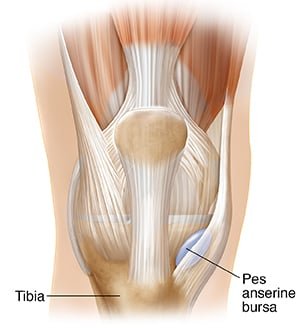
It is called PES ANSERINE BURSA, so what is Pes anserine bursitis? It is an inflammation of the bursa located between the shinbone (tibia) and three tendons of the hamstring muscle at the inside of the knee. It occurs when the bursa becomes irritated and produces too much fluid, which causes it to swell and put pressure on the adjacent parts of the knee.
Pain and tenderness on the inside of your knee, approximately 2 to 3 inches below the joint, are common symptoms of pes anserine bursitis of the knee.

I find I get it after walking, as the ground is always uneven, or stepping up, lifting the leg, and often stepping down and putting a lot of pressure on the standing leg.
What is the Cause?
Bursitis usually develops as the result of overuse or constant friction and stress on the bursa. Pes anserine bursitis is common in athletes (not me!) particularly runners. People with osteoarthritis of the knee are also susceptible. This seems to be my main contributing factor!
Several factors can contribute to the development of pes anserine bursitis, including:
Incorrect training techniques, such as neglecting to stretch, doing excessive hill running, and sudden increases in mileage
Tight hamstring muscles
Obesity
Being duck-footed or having knock knees
Osteoarthritis in the knee
What are the Symptoms?
The symptoms of pes anserine bursitis include:
Pain slowly developing on the inside of your knee and/or in the center of the shinbone, approximately 2 to 3 inches below the knee joint.
Pain increasing with exercise or climbing stairs. (Definitely my main symptom)
Puffiness or tenderness to the touch in this area. (Also a main symptom for me)
Treatment Options
Treatment of pes anserine bursitis is almost entirely non-operative.
Athletes with pes anserine bursitis should take steps to modify their workout program so that the inflammation does not recur.
Other treatments include:
Rest. Discontinue the activity or substitute a different activity until the bursitis clears up.
Ice. Apply ice at regular intervals three or four times a day for 20 minutes at a time.
Anti-inflammatory medication. Non-steroidal anti-inflammatory medication (such as aspirin, ibuprofen, and naproxen) may ease the pain and reduce the inflammation. You can also use topical NSAIDs, like over-the-counter diclofenac gel.
Injection. Your doctor may inject a solution of anesthetic and steroid into the bursa, which often provides prompt relief.
Physical therapy. Your doctor may recommend physical therapy for specific stretching exercises, and ice and ultrasound treatments.
 Hipster
Leave a comment