#ADGIFTED All thoughts and opinions are my own.
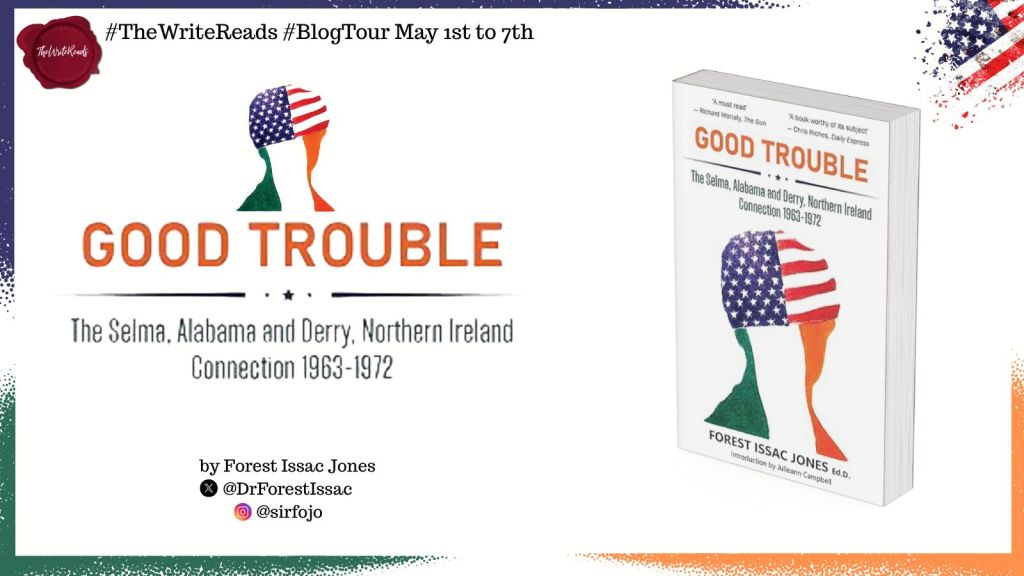
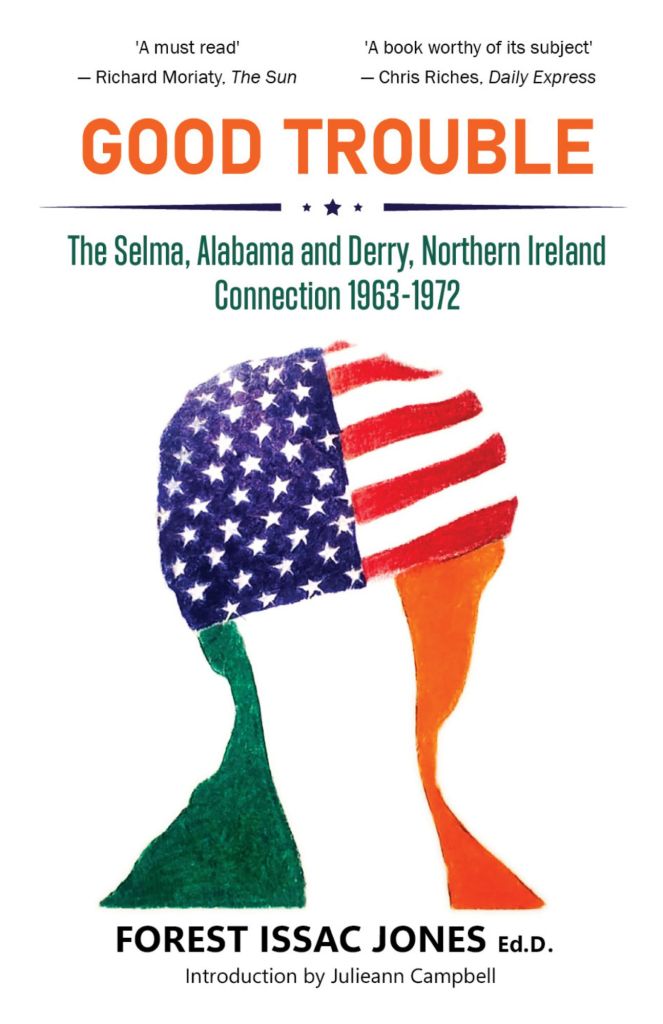
Good Trouble: The Selma, Alabama and Derry,
Northern Ireland Connection 1963-1972 by Forest
Issac Jones
Blog Tour
Book Info
Genre: Non-Fiction
Age Category: Adult
Number of Pages: 200
Publication Date: April 1, 2025
Goodreads: https://www.goodreads.com/book/show/220456296-good-trouble
Storygraph: https://app.thestorygraph.com/books/528c74fd-2baf-4bbf-bdfb-c55843105378
Amazon: https://a.co/d/fa7AIGn (Canada) https://a.co/d/iIdVkZR (USA)
https://amzn.eu/d/by31a9v (UK)
Blurb
Good Trouble will show the strong connection between the Black Civil Rights Movement in
the United States and the Catholic Civil Rights Movement in Northern Ireland – specifically
the influence of the Montgomery to Selma march on the 1969 Belfast to Derry march through
oral history, based on numerous interviews of events leading up to both marches and
afterwards. This is close to the author’s heart as both of his parents marched to integrate
lunch counters and movie theatres in Salisbury, North Carolina, in 1963 as college students.
His mother was at the 1963 March to Washington where Martin Luther King gave his ‘I Have
a Dream’ speech.
Award winning author Julieann Campbell (On Bloody Sunday) wrote the introduction for
Good Trouble, looking back at her times growing up in Derry, in the heart of the Catholic Civil
Rights Movement. Jones travelled to Dublin, Belfast and Derry to conduct interviews for the
book. In all, he did fifteen interviews with people who were involved in the movement in
Northern Ireland (including Billy McVeigh – featured in the BAFTA winning documentary,
Once Upon A Time In Northern Ireland) and in the United States (including Richard Smiley
and Dr. Sheyann Webb-Christburg – both were at Bloody Sunday in Alabama and on the
Selma to Montgomery march among others). Jones was also able to talk with Eamonn
McCann (he took part in the Belfast to Derry march in 1969; he was the John Lewis of
Northern Ireland).
Unlike most books on Northern Ireland, this goes into detail about the connection and the
influence between the two movements. Also, most focus on Bloody Sunday and not the
pivotal incidents at Burntollet Bridge and the Battle of the Bogside. Building off of unprecedented access and interviews with participants in both movements, Jones crafts a
gripping and moving account of these pivotal years for both countries.
About the Author
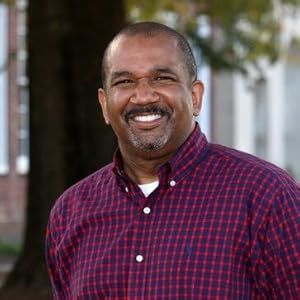
Forest Issac Jones is the author of the upcoming Good Trouble, a historical examination
about the connection between the US Black Civil Rights movement and the Catholic Civil
Rights movement in Northern Ireland. ‘An insightful and compelling examination of a terrible
period in our shared histories” (Brian McGilloway), it focuses specifically on the influence of
the 1965 Montgomery to Selma march on the 1969 Belfast to Derry march through oral
history, based on numerous interviews from people who were there on the front lines.
He is an award-winning author of nonfiction and essays, specializing in the study of Irish
history, the US Civil Rights movement, and Northern Ireland. His latest essay, ‘The Civil
Rights Connection Between the USA and Northern Ireland’ was awarded honorable mention
in the category of nonfiction essay by Writer’s Digest in their 93rd annual writing competition
in 2024.
In addition, Forest is a member of the Historical Writers Association, Crime Writers of Color,
and the James River Writers.
My Review where do I start? It was a difficult read as the subject is difficult and being English knowing that your country was the coloniser is a vile stain to have. When my heart and soul goes out for all humans regardless of colour and race. Eye opening as I did know some parts of American history and some of Ireland, but not how they mirrored each other, and I loved that comparison and how they got their protests to work. Obviously not everything went smoothly, we had a lot of deaths that could have easily been avoided. More countries should share history, see events from all angles not just your countries propaganda history. I didn’t like some of the repetitions and repeated introductions, as most were still fresh in my memory, so that felt like wasted time, going over who people were again. However that might be useful to some readers.
Tiocfaidh ár lá (Irish pronunciation: [ˈtʲʊkiː aːɾˠ ˈl̪ˠaː] TCHUH-kee ar lah); is an Irish language sentence which translates as “our day will come”. It is a slogan of Irish republicanism.
 Hipster
Leave a comment